Advanced full-face injectable treatment is not a collection of isolated injection points. It requires an integrated understanding of facial structure, soft-tissue behaviour, movement, proportion, light reflection, anatomical risk, ageing and the individual objectives of the patient.
In this masterclass, the visual principles of the Loomis Method – an artistic framework traditionally used to construct and study the human head – are adapted as an aid for analysing the face and mapping clinically relevant landmarks. Participants explore how light, shadow, contour and transition zones can inform a more coherent assessment without replacing examination, anatomy or professional judgement.
The program examines beauty ideals and proportional concepts critically, recognising that attractiveness is not reducible to a single mathematical score. It then applies a structured, patient-centred approach to four broad perspectives: the male face, the female face, the facial profile and the mature face. The aim is to support individualised planning that respects anatomy, identity, diversity and realistic treatment limits.
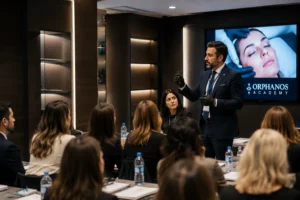
Morning lectures are followed by supervised work with selected live models where confirmed for the relevant edition. The practical component may include observation, mapping, planning, demonstration and authorised participation, depending on experience, legal scope, model suitability and the clinical safety assessment made for the relevant edition.
Evidence of an eligible healthcare qualification
Current professional registration and practising licence where applicable
Evidence of professional indemnity insurance covering the relevant procedures and hands-on training
Previous formal training in facial anatomy, consultation, complications and the injectable modalities used
Documented clinical experience in facial aesthetic injections at the level defined for the edition
Compliance with the Academy's model, consent, photography, confidentiality and infection-control policies
Any pre-course case logs, certificates or declarations requested during eligibility screening
Advanced, intimate masterclass for experienced and appropriately authorised injectors
Adaptation of Loomis principles for facial mapping
Global and historical perspectives on changing beauty ideals
Critical examination of facial proportions, harmony and golden-ratio concepts
Light, shadow, contour, reflection and transition-zone analysis
Structured assessment of facial diversity and ethnic variation
Patient needs, patient wishes, suitability and responsible treatment quantity
Integration of artistic observation with clinically relevant anatomy
Recognition of high-risk anatomical zones and treatment limits
Tailored assessment of the male face, female face, facial profile and mature face
Morning lectures followed by supervised work with selected live models
Case-based discussion, treatment planning and Q&A
The day begins by placing contemporary aesthetic practice within a broader cultural context. Participants review historical beauty trends, modern shifts and the risks of negative or overly standardised perceptions. Concepts such as golden ratios, facial harmony, attractiveness scoring and AI-assisted assessment are discussed as limited interpretive tools rather than universal truths.
The relationship between artistic sculpture and clinical facial observation is explored through an adapted Loomis framework. Facial construction is examined through shadows, contours, reflected light and transition zones, with emphasis on seeing the face three-dimensionally and identifying how skeletal structure, soft tissue, movement and surface light interact.
Facial diversity is explored through detailed assessment and recognition of ethnic and individual variation. Participants consider how to distinguish patient needs from requested changes, assess suitability, set realistic expectations and choose a proportionate treatment plan. The program links visual artistry with key anatomical considerations, high-risk zones and the professional responsibility to modify, defer or decline treatment.
The later theoretical section applies this framework to the male face, female face, facial profile and mature face. These are treated as assessment perspectives rather than rigid templates: individual anatomy and identity remain central. The live-model component then brings together consultation, photography where authorised, mapping, treatment planning, demonstration and supervised clinical participation. The procedures performed depend on the selected models and the confirmed scope of the edition.
This masterclass is intended for experienced healthcare professionals who already practise facial aesthetic injectable treatments lawfully and wish to refine full-face assessment, proportion analysis and advanced treatment planning. It is not an introductory injection course.
Admission should be limited to professional groups authorised for the procedures included in the relevant edition. Orphanos Academy must verify eligibility before confirming registration.